
Yonkers Criminal History Checks
Begin with the kind of fact you need. Yonkers Police holds its own incident and arrest reports. Yonkers City Court holds the city case docket and filed court papers. Central Booking shows the short period before arraignment, while Westchester County Correction becomes relevant only after a judge commits a person to county custody. DCJS Personal Record Review is a separate fingerprint-based route for reviewing your own statewide history.
- Identify whether the event was handled by Yonkers Police and collect the incident number, date, place, and report type.
- Ask the Yonkers Police Records Section for an ordinary report, or use Yonkers FOIL when the counter cannot release it.
- Search WebCriminal for public pending case information, then confirm the docket with the Yonkers City Court criminal clerk.
- Call Yonkers Detention for pre-arraignment custody or use Westchester Correction after judicial commitment.
- For your own fingerprint-linked New York history, use DCJS Personal Record Review through IdentoGO.
The channels should be read together, not treated as copies. An original police charge can change when a prosecutor files an accusatory instrument, and the City Court outcome can differ from the arrest label. The broader Westchester County criminal history overview explains county and state layers without turning a city report into a statewide rap sheet.
Yonkers Archived Police Records
Older Yonkers reports require more detail than a recent counter request. The archive begins in 1980, but reports from 1980 through 1986 were destroyed under the former MU-1 retention schedule. A name alone cannot search a pre-2011 report. For records before 1996, the incident number is required. Those limits are real gaps in the city archive, not proof that an event never occurred.
Use the official Yonkers archived report form. It asks for contact details, a description, relevant dates, incident numbers, record category, reason, and signature. The search fee is $5. Yonkers directs the requester to call after two to three weeks, and a retrieved report costs another $15.
When the incident number is missing, work backward from the best facts still known: date, time, location, and type of event. City Court may also hold a docket number tied to the same prosecution. The archive rule makes precise event facts more useful than a broad name request.
Records at Yonkers Police
The Yonkers Police Records Section is at 104 South Broadway, second floor, Yonkers, NY 10701. Its number is 914-377-7232, and its fax is 914-377-7235. The counter is open Monday through Friday from 9 a.m. to 3 p.m., except holidays. Reports are not issued at precincts. Most non-accident reports become available within eight business days, and Yonkers does not send them by fax or email.
Yonkers Police Records Section
104 South Broadway, 2nd Floor
Yonkers, NY 10701
914-377-7232
Monday-Friday, 9 a.m.-3 p.m.
The city's Records Section rules and fees are shown in the official source captured below.
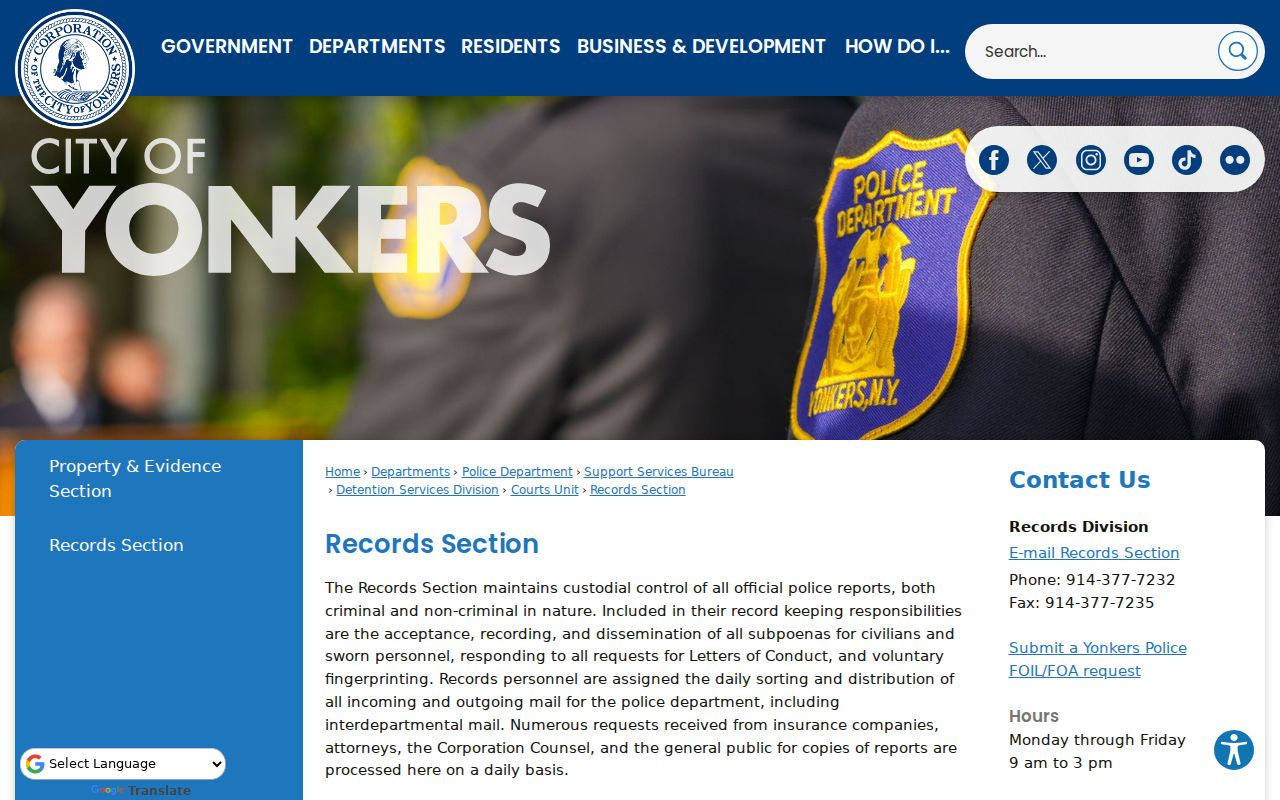
The city page confirms why a records-counter request needs a precise report type and why a precinct visit will not produce the file.
Yonkers Conduct Certificates Explained
A Yonkers Certificate of Conduct is not a New York criminal-history report. It searches Yonkers Police records for a Yonkers conviction. It does not combine court, county, and statewide events, and it should not be read as proof that no record exists elsewhere.
| Product | Coverage | Method |
|---|---|---|
| Certificate of Conduct | Yonkers Police record search for a Yonkers conviction | In person with valid ID |
| DCJS Personal Record Review | Your fingerprint-linked New York record | IdentoGO fingerprint appointment |
| City Court file | Filed charges, dates, orders, and disposition in one case | WebCriminal and clerk request |
The certificate costs $30 for a Yonkers resident and $60 for a nonresident. Yonkers also offers voluntary fingerprinting by appointment at 914-377-7232, at $50 for residents or $75 for nonresidents, with cards costing $1. YPD does not submit those prints to DCJS, so the service should not be confused with IdentoGO record review.
Booking and Arrest Records in Yonkers
Yonkers operates its own pre-arraignment City Jail and Central Booking at 104 South Broadway. Police process charges, photographs, fingerprints, and lodging there before the first court appearance. The Detention Services number is 914-377-7252. The Warrant Squad can be reached at 914-377-7253, 914-377-7267, or 914-377-7268.
The official Yonkers Detention Services Division source illustrates the city booking channel.
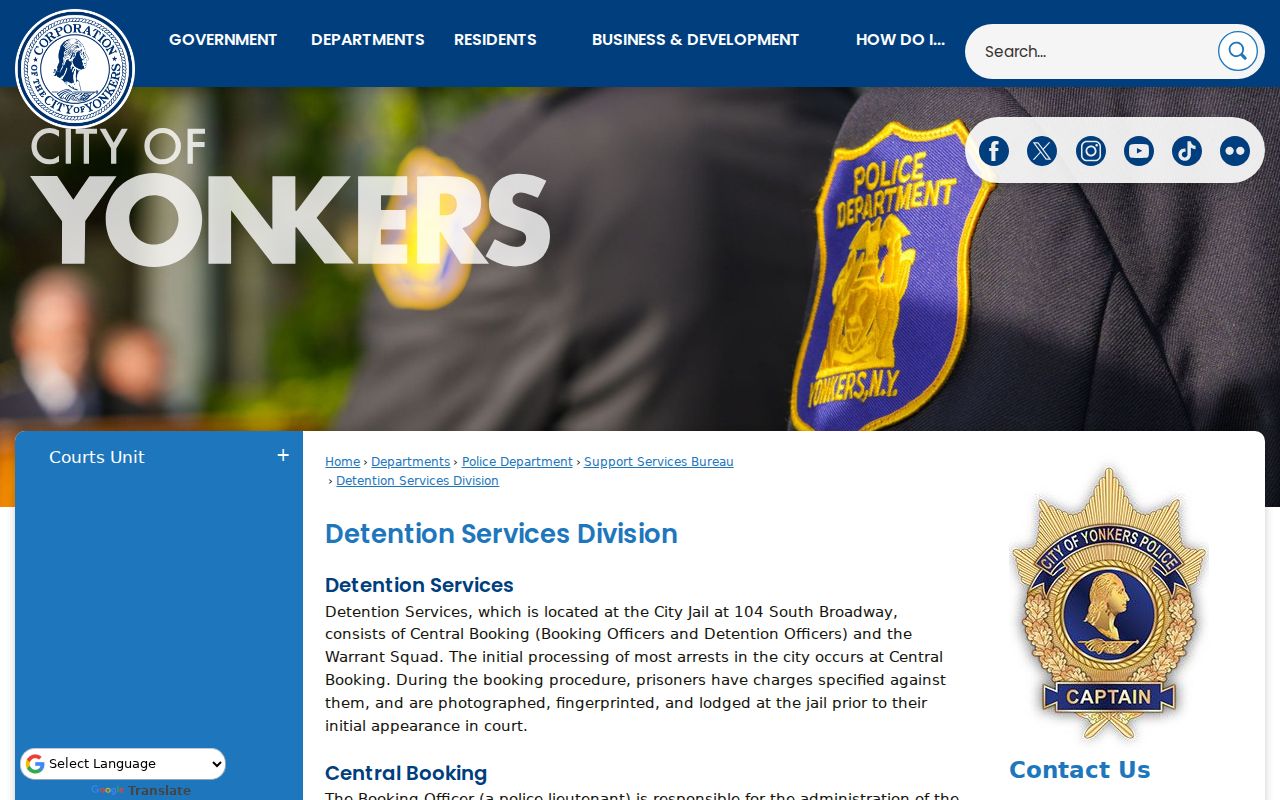
That city function ends when a judge remands the person. After commitment, Westchester County Department of Correction in Valhalla is the custody source, which is why a Yonkers booking search can require two offices.
Yonkers Booking to County Custody
City and county custody are sequential, not competing rosters. Before arraignment, call Yonkers Detention. If the court releases the person, no county jail entry should be expected. If the judge issues a commitment, Westchester Correction receives the person and its public custody lookup may then show available status and bail details.
Custody path: Yonkers arrest › Central Booking › Yonkers City Court arraignment › release or Westchester County Correction commitment.
A missing county match shortly after arrest does not settle whether someone was in Yonkers custody. It may mean the arraignment has not occurred, release followed arraignment, or the county system has not yet posted the commitment. For the case outcome, move from custody data to the court file.
The Yonkers Municipal Court File
Yonkers City Court sits in the R.W. Cacace Justice Center at 100 South Broadway. The main number is 914-831-6450, and the criminal clerk is 914-831-6930. Court hours are Monday through Friday from 9 a.m. to 5 p.m. The court handles city misdemeanors and violations, arraignments, and preliminary felony proceedings before an indicted felony moves to Westchester County Court.
| Court Name | Yonkers City Court, R.W. Cacace Justice Center |
|---|---|
| Case Types Heard | Misdemeanors, violations, arraignments, and early felony proceedings |
| Case Lookup Channel | WebCriminal for public pending information, then the criminal clerk |
| What the Docket Shows | Case number, filed charges, appearances, status, orders, plea, and disposition when public |
| Copies and Fees | Ask the clerk for current copy or certification terms; no city-court copy fee was confirmed |
WebCriminal is useful for a public pending case or calendar, but an older, disposed, or omitted matter may require the clerk. Ask with the exact name, docket number, and approximate date. Sealed matters, youthful-offender records, and grand-jury material are not opened by a routine search.
Yonkers Crime Records in Context
DCJS counted 2,942 reported index crimes in Yonkers for 2024. The total comprised 805 violent index offenses and 2,137 property index offenses. The detailed categories included 7 murders, 31 rapes, 200 robberies, 567 aggravated assaults, 284 burglaries, 1,538 larcenies, and 315 motor-vehicle thefts.
These are police reports grouped into seven index-crime categories. They are not counts of arrests, defendants, or convictions. One case can change charge level, and some reports never result in an arrest. Use the figures to understand city workload, not to infer any person's history.
How Yonkers Records Reach the County
Yonkers Police creates the incident and arrest record. After arraignment and any transfer, court clerks maintain the public case papers while prosecutors and courts report qualifying events to DCJS. A felony can begin in Yonkers City Court and later move to Westchester County Court after indictment. That transfer does not move the original YPD narrative to the county clerk.
Record flow: Yonkers Police › Yonkers City Court › Westchester County Court when transferred › New York State Division of Criminal Justice Services.
Search the city source for the report, the court source for filed charges and disposition, and DCJS only for your own fingerprint-linked record. This split explains why no single Yonkers name search is a complete criminal history.
Yonkers Police Records by FOIL
Use the Yonkers FOIL form when the ordinary counter cannot release a report or when a formal city response is needed. Select Police as the department. Give names, representation details if applicable, mailing and contact information, plus a narrow description with the incident date, location, report number, and record type.
Copies up to 9 by 14 inches cost as much as $0.25 per page. Other media may be charged at actual cost, and the city may require advance payment. Open investigations or prosecutions, sealed reports, protected witness details, and personal information can be withheld or redacted. An attorney seeking a criminal report through the ordinary route needs authorization, while a named person may pick up a report subject to access limits.
Ask for reasonably segregable public portions when only part of a record is exempt. A narrow request is easier to search and less likely to be delayed by broad date ranges or unclear event descriptions.
Yonkers Records Across Time
Yonkers grew from the area associated with Adriaen van der Donck and the Dutch title “jonkheer,” through Nepperhan mills, Philipse Manor Hall, and Otis elevator works. Its 4.5 miles of Hudson waterfront and broad rail and road network add more than local color. They help explain why city, county, MTA, and state agencies may each create records tied to events within or near Yonkers.
That long city record also affects archive work. A modern name search cannot bridge every gap in older Yonkers police files. Researchers should pair an address, date, event type, and incident number with historical sources when available. The Records Section, City Court clerk, and city archive serve different roles, so the age and kind of record determine where a Yonkers search should start.
Agency identity still controls access. A Yonkers Police report stays with YPD. A rail-related event handled by another authority must be requested from that authority. The city archive's retention gaps also show why a court disposition or personal DCJS review can survive even when an old police report cannot be retrieved.
For genealogy or historical work, write down the source of each fact as it is found. A Yonkers archive form, a City Court certification, and a DCJS response have different legal scope. The archived police form focuses on an event and asks why the record is sought. A court certification confirms what the clerk's file states. Personal Record Review connects fingerprint-based cycles for the person who ordered it. Keeping those labels with the copies prevents an old report from being mistaken for a final judgment.
The same care helps when dates fall near the known archive cutoffs. A pre-2011 search needs more than a name, and a pre-1996 request needs the incident number. Reports from 1980 through 1986 cannot be recovered from YPD because they were destroyed under the applicable retention schedule. A researcher can still ask whether a public court file or later state record exists, but should not claim that one source recreates the missing report.
Yonkers Record Access Rules
New York law separates agency records, judiciary records, and fingerprint-linked criminal history. Yonkers answers police requests under FOIL. City Court records come from the clerk under court-record law. DCJS does not release another person's rap sheet through FOIL. Sealed cases, youthful-offender matters, confidential grand-jury material, and protected investigative facts remain outside ordinary public access.
Key Statutes:
Public Officers Law Article 6 opens agency records subject to law-enforcement, privacy, safety, and confidentiality exemptions.
Judiciary Law §255 directs court clerks to search and certify court records as law and court rules allow.
CPL §160.50 generally seals a matter that ends in favor of the accused.
Portal silence is not proof of a clean record. It may reflect sealing, an older file, a local court not well represented online, or a record held by a different agency. Verify public facts with the office that created or maintains them.